Showing posts with label Fish Art. Show all posts

Saturday, February 21, 2015

FISH ART: The Skilcraft Visible Trout Model

By Peter J. Park


Many years ago, a company named Skilcraft made the most realistic fish model kit on the market. It was called "Visible Trout." I was fortunate to purchase a Visible Trout model kit at a gift shop in Homer, Alaska during the summer of 2006.

I believe this model kit is now discontinued, which is a shame because it was very well done. I am sure many students of biology enjoyed learning the anatomy of an actinopertygian (ray-finned) fish using this trout model kit. I found the model to be pretty accurate, and I intend to use it to teach fish anatomy to Nyack College Fishing Club members.

As advertised, the Visible Trout model kit included the following features (see box cover):
- Anatomically accurate
- Modeled from an actual specimen
- Finally detailed
- Ideal for school projects
- Includes fully illustrate guide


The kit contained two booklets:
(1) A Guide to the Their [Trout] Anatomy
(2) Visible Trout Instruction Manual


Model kit parts for the Visible Trout were numerous (but manageable), intricate, detailed, and indeed accurate. Just to give you a sense the complexity of this fish model, below are pages from the instruction manual.


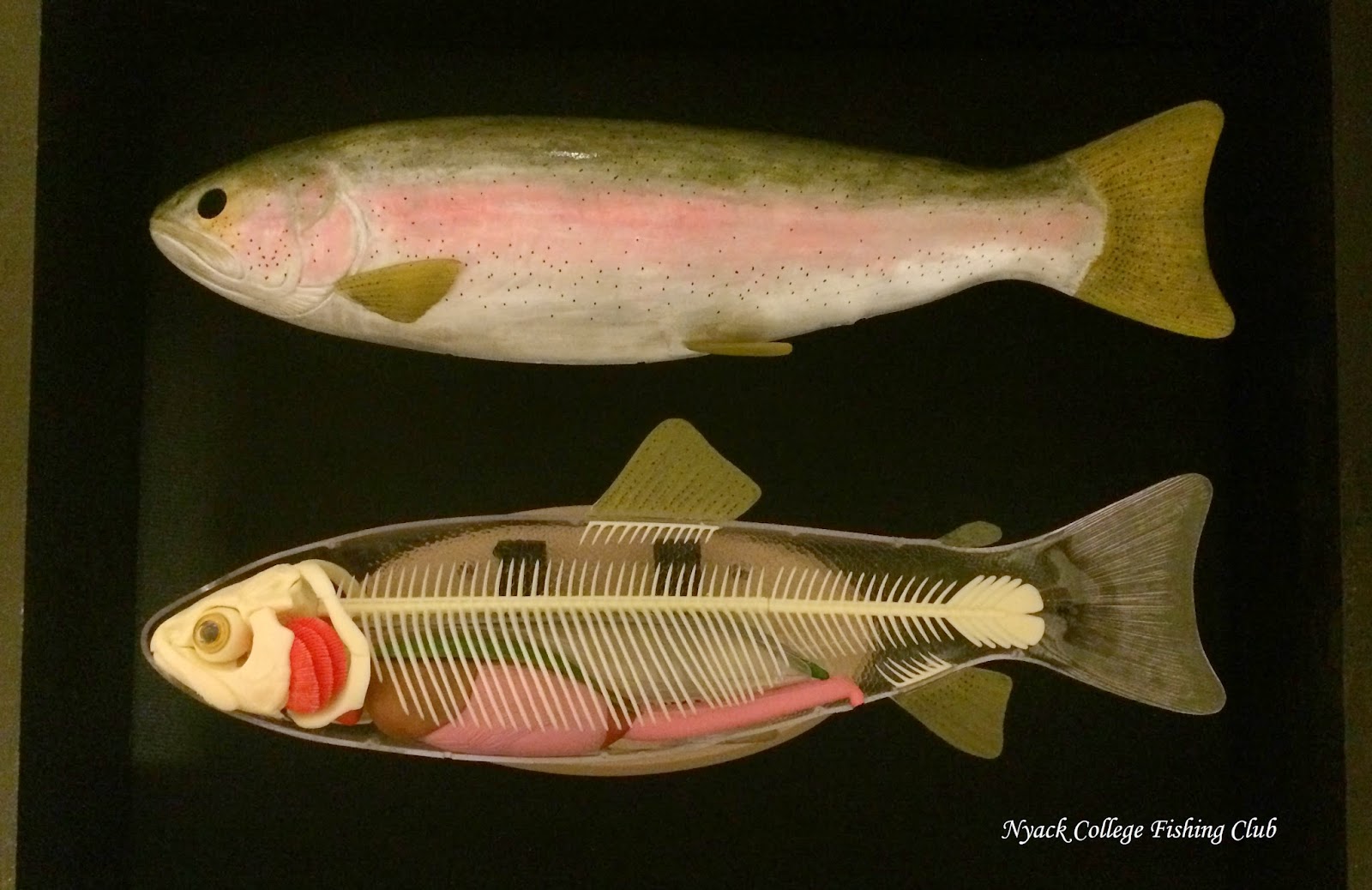
Below are pictures of my completed Visible Trout model. I implemented a couple of variations from the original design: (1) internal organs and eyes were painted, usually but not always, in the suggested colors as outlined in the provided manual. (2) instead of keeping the outer body form case clear, as provided by the model kit, I painted it like a rainbow trout. All paintwork was done using Daler-Rowney acrylic paints.




And finally, below is a video of the completed Visible Trout model.


Friday, February 4, 2011

FISH ART: Marine Creations Taxidermy - Painting a Fish Replica

By Peter J. Park


Michael P. Kroessig is an accomplished wildlife artist. He has a passion for fish and fishing and is the founder and owner of Marine Creations Taxidermy (http://www.marinecreations.com/). His specialty is painting fish replicas for anglers, museums, and sporting mega-stores. When a customer commissions a replica, all that the client needs to provide Mr. Kroessig is a photograph.


The process of building a replica begins as follows. Once Mr. Kroessig knows the size and weight of the fish that he needs to match, he acquires an exact-sized replica (usually fiberglass) version of the fish, called a "fish blank." Depending on the fish, he can either construct the blank himself or acquire one through a company that sells them. 

Here is a list of some companies that sell fish blanks:

The fish blank is either sculpted from scratch or created using a mold. Molds are constructed using real fish, and a single mold can produce hundreds of fiberglass copies ("blanks")  of that fish. For more info on this procedure, see the video below:


Thus, the need to sacrifice an angler’s trophy catch for the sake of a mount is no longer needed. The inventories of molds possessed by these companies are quite comprehensive.

Below is an example of the process from fishing memory to fish replica for my most memorable catch. 

Here is a 70+lb wahoo (Acanthocybium solandri) that I caught during a trip with Capt. Mike Jackson of Liveline Fishing Charters (http://livelinecharters.com/), out of Wilmington, North Carolina. The wahoo is a close relative of the Atlantic mackerel, but it is much bigger and more formidable than most mackerel species. The wahoo is a pelagic species that is a popular and prized sport fish because of its speed, strength, and size.

Photo of the catch: 
70+lbs wahoo


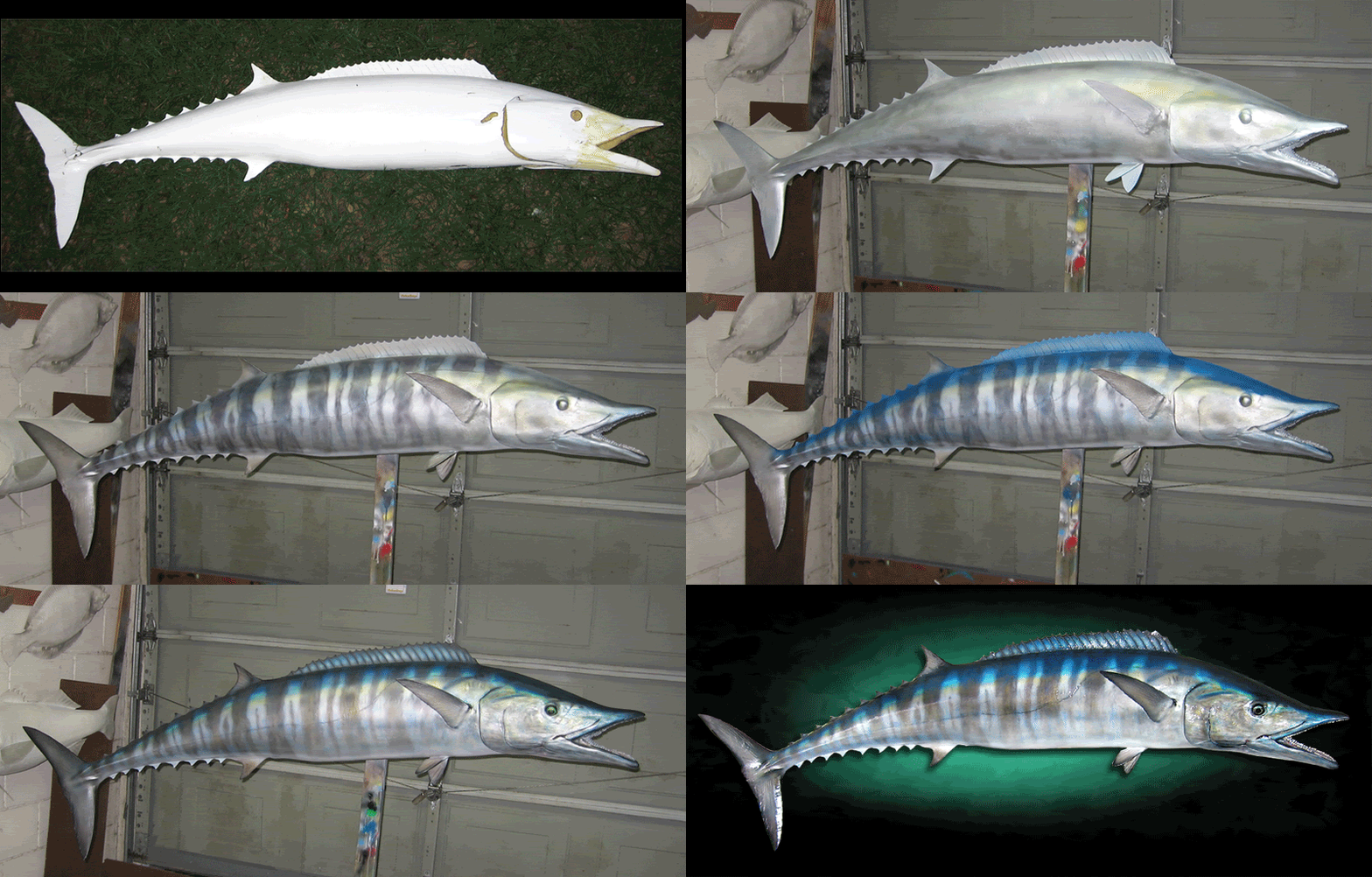
Below is a list of photographs that documents Mr. Kroessig's time, hard work, and attention to detail while completing a replica of this wahoo. Believe me when I tell you, he does this for every client's fish!


Step 1. The fish blank in its raw form. It has to be cut, carved, and polished by the artist, and some fins need to be attached later. (Note that this blank is NOT a real fish; it is a fiberglass blank made from a mold.):

The mouth is usually filled with foam and it too must be cut out:


Step 2. The entire mouth and individual teeth must be constructed, sculpted, and inserted:


Step 3. Once the blank is completely assembled, it is primed and prepared for paintwork:


Step 4. The paintwork is summarized in the following three phases.

Phase I:


Phase II:


Phase III:


Step 5. The accents and finishing touches that mimic features of the actual fish are added.
For example, adding scars:


Step 6. The finished mount is then glossed:


Step 7. Finally, after many months, it is complete.

Step 8. The fish replica is then carefully crated and then shipped safely to its new home.